Understanding the Relationships Between Mass and the System of Forces Acting on a Body Experiencing Constant Speed Translational Motion Across Horizontal and Inclined Planar Surfaces
Laboratory No. 4
Introduction. When a smooth block is set sliding on a smooth horizontal floor, we note that it moves in a straight line but gradually slows down and comes to a stop. Why does it not obey the Law of Inertia (Newton's First Law) and continue at constant speed? The answer is that there is an unbalanced force acting on it. This is the force of friction exerted upon it by the floor. Friction may be defined as the force that resists a body when it moves over or through another body. Thus a projectile, once set in motion, is slowed down by friction as it moves through the air. The block in our example is therefore slowed down by friction as it moves over the floor.
Friction explains why a car, once set in motion, will not continue to move at constant speed on a horizontal road without further help from the engine. The frictional resistance of the road to its forward motion and of its axles to the motion of its wheels over them gradually brings the car to a halt once the engine is turned off. It follows that, to keep the car moving at constant speed, the engine must supply just enough force to overcome the retarding force of friction. With the force of friction neutralized in this manner, there are no unbalanced forces acting on the car and it obeys the Law of Inertia.
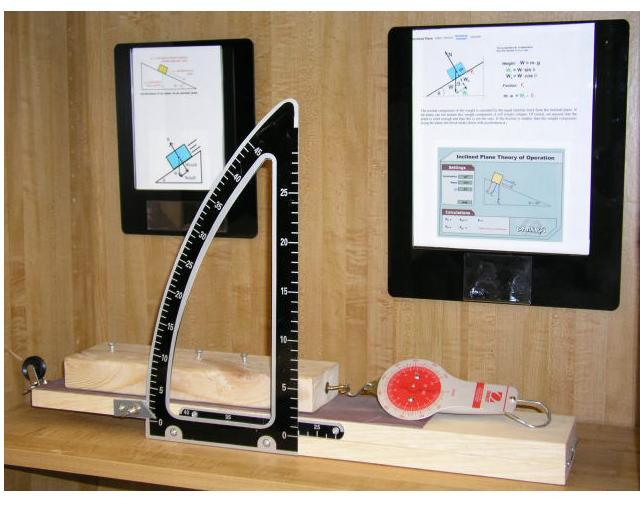
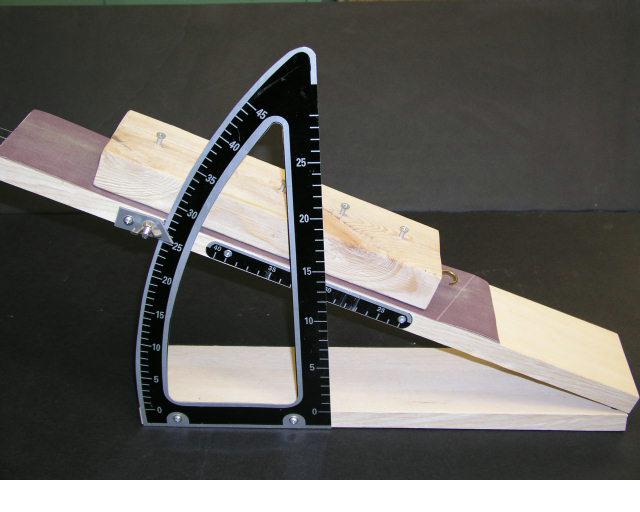
Equipment (See pictures at right and below)
12.0 inch x 4.0 inch x 2.0 inch solid pine friction block
Threaded brass attaching hook
Ten mass-fastening screws
Set of assorted slotted masses
Spring scale
Triple beam balance
Meter stick
Inclined plane apparatus
Sandpaper friction surface
Tasks
1. The rectangular friction blocks employed in this laboratory exercise are constructed of solid pine, each possessing a length of 12.0 inches, a width of 4.0 inches, and a height of 2.0 inches. Assuming that each and every block is internally consistent and uniform, and neglecting the attached hardware (mass-fastening screws and attaching hook),
a. measure the mass [m1] of your unladen friction block: __________ (kilograms)
calculate the mass [m2] of your friction block with added 200 g mass: __________ (kilograms)
calculate the mass [m3] of your friction block with added 500 g mass: __________ (kilograms)
3. Based on your lab data calculate
a. the coefficient of static (starting) friction [ms] for
the unladen block resting on the greatest area side [ms1] __________ ms1 = Fs1/Fg1
the block with 200 g added resting on the greatest area side [ms2] __________ ms2 = Fs2/Fg2
the block with 500 g added resting on the greatest area side [ms3] __________ ms3 = Fs3/Fg3
b. the coefficient of kinetic (sliding) friction [mk] for
the unladen block resting on the greatest area side [mk1] __________ mk1 = Fk1/Fg1
the block with 200 g added resting on the greatest area side [mk2] __________ mk2 = Fk2/Fg2
the block with 500 g added resting on the greatest area side [mk3] __________ mk3 = Fk3/Fg3
3. Based on your lab data, your calculations above and your knowledge of forces, briefly explain the
observed relationship between
the mass of an object and the pulling force required to overcome the force of
friction to set the object in motion __________________________________
4. Briefly explain the observed relationship between an object's contact area and frictional force. Name the principal factors that either enhance or diminish the force of friction which acts to retard
an object's movement in contact with and respect to another object across a horizontal surface.
5. Prepare graphs of your Fp (pulling force) versus Fn (normal force) data acquired in each experimental situation. The graph should present your data acquired from sliding the friction block along the side with the greatest contact area. Pulling forces required to overcome kinetic (sliding) friction and maintain a constant rate of motion are to be plotted only. Organize your graphs so that pulling force (Fp, which also incidentally equals Ff in magnitude) appears on the ordinate and Fn (which also incidentally equals weight in magnitude) appears on the abscissa. How do the slopes of your graphed lines compare with one another? What does the slope of each line reveal about the relationship between mass, pulling force, and frictional force? To which numerical value that we have previously analyzed is the slope equal? Explain.
b. calculate the weight [Fg1] of your unladen friction block: __________ (Newtons)
Equation: Fg1 = m1g
calculate the weight [Fg2] of your friction block with added 200 g mass: __________ (Newtons)
Equation: Fg2 = m2g
DATA TABLE
6. EXTRA CREDIT: Briefly derive an alternate experimental method for determining the coefficients of static and kinetic friction for our apparatus that does not involve the use of a spring scale.
[Hint: Examine the photograph of the apparatus shown above carefully and thoughtfully.]
2. Place the friction block on the sandpaper friction surface which has been affixed to the
inclined plane apparatus. Attach the hook of the spring scale to the hook on the friction block.
While holding the spring scale horizontally, apply a steady force [while carefully observing the motion of the pointer on dial of the spring scale]until the friction block begins to slide. The highest force reading to which the pointer has rotated will be the force of static (starting) friction [Fs]. Repeat for the block with 200 g added and repeat again for the block with 500 g
added. Record the measurements in the Data Table provided.
2. Place the friction block on the sandpaper friction surface which has been affixed to the
inclined plane apparatus. Attach the hook of the spring scale to the hook on the friction block.
While holding the spring scale horizontally, apply a steady force [while carefully observing the motion of the pointer on dial of the spring scale]until the friction block begins to slide. Once sliding motion has been initiated, continue to apply sufficient force to maintain the sliding of the friction block at a constant rate of speed. The steady force reading to which the pointer has rotated while the block is sliding will be the force of kinetic (sliding) friction [Fk]. Repeat for the block with 200 g added and repeat again for the block with 500 g added. Record the measurements in the Data Table provided.
Fs1
Fs2
Fs3
Fk1
Fk2
Fk3
calculate the weight [Fg3] of your friction block with added 500 g mass: __________ (Newtons)

 Friction explains why a car, once set in motion, will not continue to move at constant speed on a horizontal road without further help from the engine. The frictional resistance of the road to its forward motion and of its axles to the motion of its wheels over them gradually brings the car to a halt once the engine is turned off. It follows that, to keep the car moving at constant speed, the engine must supply just enough force to overcome the retarding force of friction. With the force of friction neutralized in this manner, there are no unbalanced forces acting on the car and it obeys the Law of Inertia.